
Disclosure: This page contains affiliate links. We may earn a commission if you buy through them. Last updated: 21 September 2026. This is a buying-approach guide, not electrical-code, tax, or installation advice. Confirm current incentives with a qualified tax professional. We do not operate an in-house lab. How we review.
For a decade the U.S. pitch was simple: install a wall battery, take a federal percentage off. That pitch broke for most homeowner-owned batteries placed in service after 31 December 2025, when the Residential Clean Energy Credit (25D) for those systems ended.
A $10,000–$16,000 installed pack is still the right tool for some houses. It is no longer the default first click. Size the load first — Size the Load — then decide whether a portable or modular station can do that job.
What changed (and what did not)
- Changed: the 30% federal credit that made many homeowner-owned batteries pencil out is gone for systems placed in service after 31 Dec 2025, unless a narrower leftover applies to your facts.
- Did not change: physics. Watts start the compressor. Watt-hours keep food cold. Refrigerator.
- Did not change: state, utility, or installer rebates that may still exist locally. This page does not list every program.
- Did not change: 240 V well pumps and heat-pump air handlers. A 1 kWh portable with 120 V outlets is not a panel.
If a sales page still leads with “30% off a Powerwall-class install” in 2026, the page is stale.
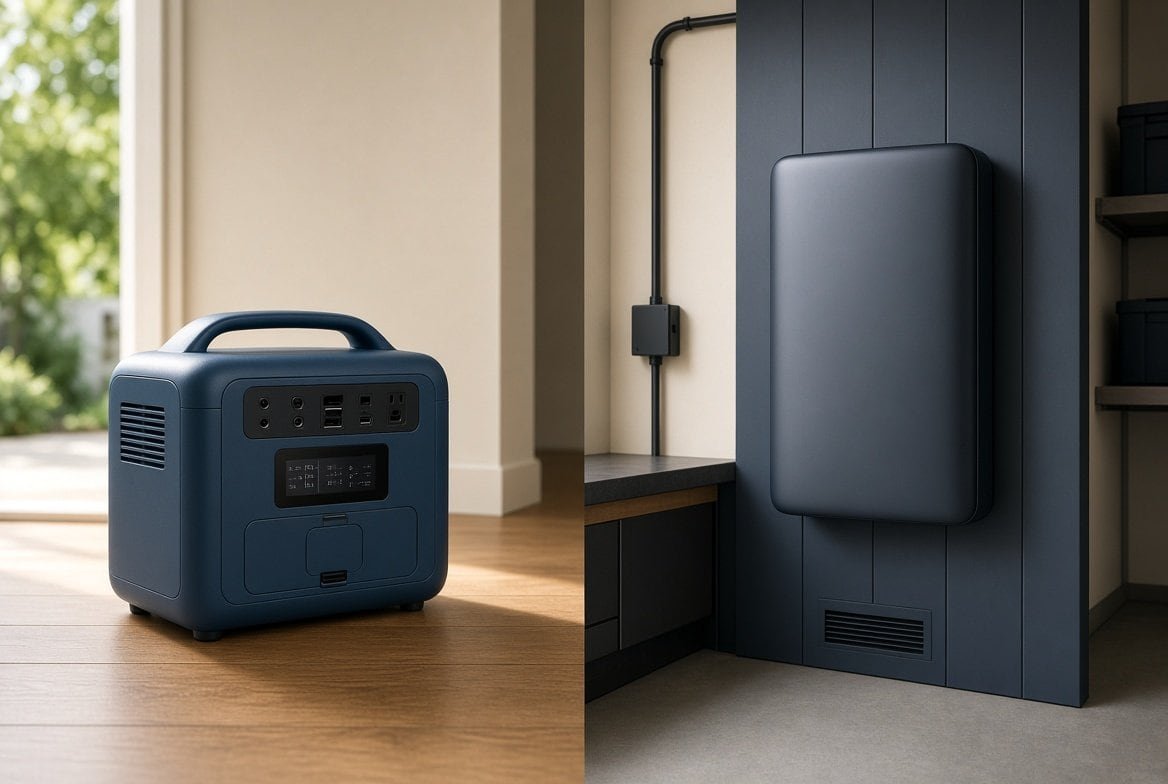
Two products, two jobs
| Portable / modular station | Installed home battery | |
|---|---|---|
| What it is | Appliance you plug loads into, or a modular pack you can expand | Battery + inverter tied to the electrical panel |
| Typical outlay | About $400–$4,000 for 0.3–2 kWh class; more if stacked | Often $10,000–$16,000+ installed |
| Who can use it | Homeowners, renters, apartments — no panel work required for outlet use | Usually a home you own, a permitted install, an electrician |
| What it covers well | Fridge, CPAP, router, lights, a work block | Selected circuits or whole-home, including some 240 V loads |
| What it does not cover | A heat pump + dryer + well pump on a travel pack | A renter who cannot touch the panel |
| Recharge | Wall outlet and/or solar into the station | Solar-to-home and grid rules on the interconnect |
“Solar generator” in ads is still a battery + panel. Night hours still come from the bottle. Size the Load.
When portable / modular is enough
Use a station when the critical list is short and named:
- Overnight or 24-hour top-freezer plus a router — Refrigerator.
- One CPAP night, humidifier on or off — CPAP.
- Apartment / rental where a transfer switch is not an option.
- You want a tool you can carry to a car or a relative’s house.
A 1 kWh class station is an overnight tool. A 2 kWh or stacked modular pack is a storm-weekend food tool. Neither is a silent whole-home generator.
When only an installed pack is honest
Stay in the installed lane when:
- The job is 240 V well, heat pump, or several kitchen circuits at once.
- You need automatic transfer when the grid dies and nobody is home to plug in a fridge.
- You are pairing a large rooftop array to time-of-use shifting, not just outage food.
Do not buy a $15k install to keep a CPAP on. Do not buy a 300 W travel station to replace a panel.
The 2026 money question
Ask, in order:
- What must stay on, in watts and hours?
- Does a portable inverter start that load (surge)?
- Do usable watt-hours cover the dark hours (×0.85 unless a named test says otherwise)?
- Only then: is an installed pack buying you 240 V, automation, or solar pairing that the station cannot?
If the answer to 2–3 is yes, the expired credit is an argument for portable/modular, not a reason to spend five figures out of habit.
Regional notes (same English page)
- United States: 120 V outlets on most portables. Split-phase 240 V is a specific SKU, not a hope. Confirm any remaining state/utility battery incentive separately from the expired 25D homeowner credit.
- Canada: cold-weather derate; keep LiFePO4 indoors.
- UK / EU: 230 V local SKU. A balcony/backfeed product is legally different from a station that only powers its own outlets.
- Australia: portable-as-appliance vs export-into-wiring are different classes. Installed packs may still see rebate support; portables usually do not.
FAQ
Worth it if you need panel-tied 240 V or automatic whole-home backup. Often not worth it if the real job is a fridge and a CPAP.
No. It can replace the job a lot of households bought the wall battery to do: food, comms, sleep therapy.
The widely used federal 25D path for most homeowner-owned batteries placed in service after 31 Dec 2025 did. Local leftovers are fact-specific.
For a final SKU, yes. For the portable-vs-installed fork, no — finish the load card first.
Method: How we review.
Corrections: Contact.
Disclosure: Affiliate disclosure.